
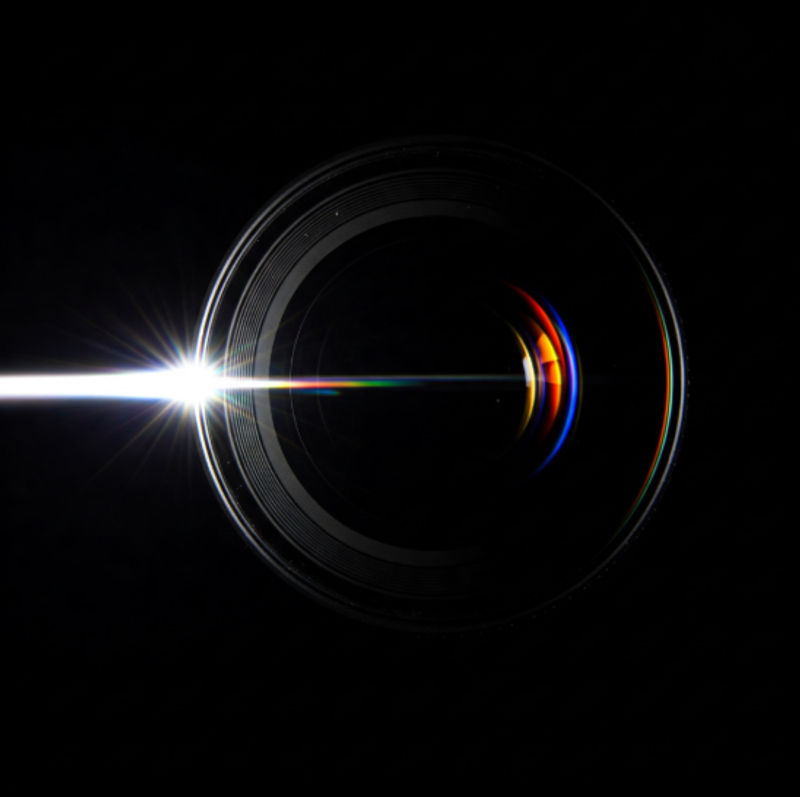
Curious about the intricacies of lens performance? It involves more than just the lens's construction. Here's an accessible breakdown of the factors influencing lens quality and the reasons why selecting the appropriate lens is vital.
Aberrations: Imperfections in Imaging
Aberrations can be likened to distortions in a funhouse mirror, altering the image in undesirable ways. Various types of aberrations produce distinct image distortions:
- error_circle_roundedSpherical Aberration: Causes blurriness, particularly noticeable at wider apertures. It resembles a haze over the entire image.
- error_circle_roundedField Curvature: The image center and edges won't be in focus simultaneously.
- error_circle_roundedAstigmatism: Vertical and horizontal lines focus at different points. Picture a cross with one line sharp and the other blurred.
- error_circle_roundedComa: Makes points of light appear comet-shaped. The effect worsens with larger apertures.
- error_circle_roundedDistortion: Straight lines appear curved, creating "barrel" or "pincushion" effects.
- error_circle_roundedChromatic Aberration: Different colors focus at different points, resulting in color fringes.
The positive aspect is that smaller apertures (higher f/#) often mitigate some of these aberrations.
MTF Curves: Quantifying Image Sharpness
MTF stands for Modulation Transfer Function, essentially representing contrast. An MTF curve visually depicts how well a lens maintains sharpness and clarity at varying levels of detail.
Contrast
The difference between light and dark areas. High contrast means distinct blacks and whites, while low contrast appears washed out.
Frequency
The amount of detail packed into a space. Think of it like pixels -- more pixels, more detail.
MTF curves help visualize how different aberrations impact a lens's performance. It's important to remember that lens performance can fluctuate significantly based on factors like aperture and the colors of light being used.
Relative Illumination: Evenness of Light Distribution
This aspect concerns how uniformly a lens distributes light across the image. Occasionally, the center appears brighter than the edges, which can be problematic, especially for measurement applications where consistent lighting is key.
Lens Design Tradeoffs: Balancing Performance and Practicality
Unfortunately, a single perfect lens doesn't exist. Some lenses excel at close-ups, while others are designed for distant subjects. When choosing a lens, prioritize the most critical factors:
- Resolution
- Distortion
- Image Brightness
- Cost
Larger lenses generally offer better performance but tend to be bulkier and more expensive. Wide-angle shots at close distances often come at the expense of image quality.
It's worth noting that lens calculators should be used with caution, as they rely on assumptions that may not always hold true in real-world scenarios. Ultimately, the ideal lens depends on the subject matter and desired outcome. It's about selecting the right tool for the task.
Frequently Asked Questions
What are the main optical issues that affect lens quality?
We're talking about things like blurring, focus inconsistencies, image distortion, and color fringing. These are called "aberrations," and they impact how clear your image is.
How do we measure a lens's sharpness?
We use something called an "MTF curve." It tells us how well a lens transfers contrast, essentially showing how sharp the image will be. Higher values mean sharper images.
What's the best ratio between working distance and field of view?
A 4:1 ratio (working distance to field of view) is generally a good starting point. It balances performance and cost.
How does the lens aperture (f/#) affect image quality?
The aperture influences how aberrations appear. Smaller apertures (higher f/#) often reduce blurring and other issues.
Why can't one lens do everything?
Lens designs are specialized. Each lens is optimized for specific tasks, so trade-offs are necessary. There's no "one-size-fits-all."
How accurate are lens calculators?
They provide estimates, not exact results. They simplify lens behavior, so they're best used for ballpark figures, especially with short focal lengths.
What is "relative illumination"?
It's how evenly bright the image is. A curve shows the brightness across the image, and the brightest spot isn't always in the center.
What are the key things to consider when choosing an imaging system?
You'll need to consider: Field of View (FOV), Working Distance (WD), Resolution, Depth of Field (DOF), Sensor Size. Common trade-offs involve balancing resolution and depth of field, as well as cost.