
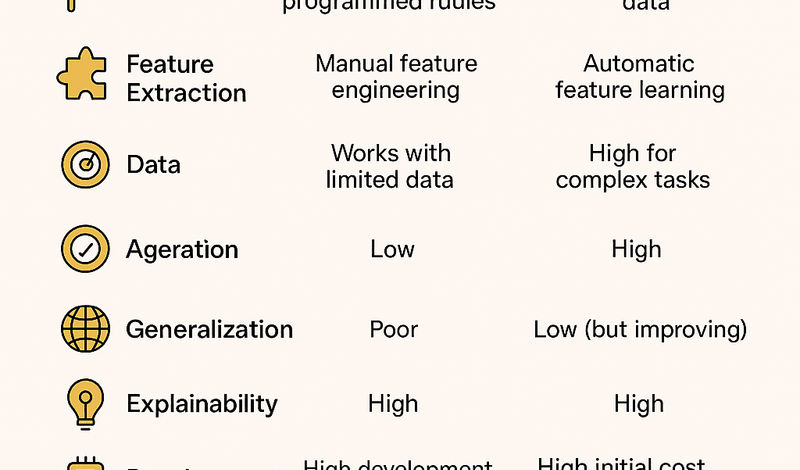
Machine vision, a field of artificial intelligence (AI), empowers computers to "see" and interpret images, much like the human eye. This technology finds applications across diverse industries, including manufacturing, healthcare, and security. Within machine vision, two primary approaches stand out: rule-based and deep learning. This report delves into the fundamental differences between these two methodologies, highlighting their strengths, weaknesses, and optimal use cases.
Rule-Based Machine Vision
Rule-based machine vision, also known as traditional machine vision, relies on predefined rules and algorithms to analyze images. These rules, crafted by human experts, instruct the system on how to process visual data and make decisions.
Key Characteristics:
- check_circleExplicit Programming: Requires engineers to manually define every step involved in image analysis.
- check_circleFeature Engineering: Relies on extracting specific features from images, such as edges, shapes, and colors, using classical image processing techniques.
- check_circleDeterministic: Produces consistent results for the same input, as it follows a fixed set of rules.
- check_circleTransparency: Offers clear explainability, as the decision-making process is transparent and traceable to the defined rules.
Strengths
- Accuracy and Precision: Excels in tasks requiring high precision and accuracy, such as dimensional measurements and object positioning.
- Speed: Can be computationally efficient, enabling fast processing, especially for simple tasks.
- Explainability: Provides transparent and understandable results.
- Low Data Requirements: Can work effectively with limited datasets.
Weaknesses
- Limited Adaptability: Struggles with variations in image quality, object appearance, and environmental conditions.
- High Development and Maintenance Costs: Requires significant manual effort to design, implement, and maintain the rules, especially for complex tasks.
- Inability to Generalize: Cannot effectively handle new or unexpected scenarios that were not explicitly programmed.
- Complexity with Complex Tasks: Becomes very complex with a large number of rules.
Use Cases:
- Quality Control: Inspecting manufactured parts for defects in well-defined settings.
- Object Measurement: Determining the dimensions of objects with high precision.
- Barcode Reading: Decoding barcodes with consistent formatting.
- Optical Character Recognition (OCR): Reading text in controlled environments.
Deep Learning Machine Vision
Deep learning, a subfield of machine learning, utilizes artificial neural networks to automatically learn patterns and features from vast amounts of image data. These networks, inspired by the structure and function of the human brain, can learn to perform complex tasks without explicit programming.
Key Characteristics:
- check_circleAutomatic Feature Learning: Learns relevant features directly from the data, eliminating the need for manual feature engineering.
- check_circleData-Driven: Relies on large datasets to train the neural networks.
- check_circleProbabilistic: Provides a level of confidence or probability for its predictions.
- check_circleBlack Box: The decision-making process can be opaque, making it challenging to understand why a particular output was generated (though explainable AI is improving this).
Strengths
- High Accuracy: Can achieve state-of-the-art accuracy in complex tasks, often surpassing human-level performance.
- Adaptability: Robust to variations in image quality, object appearance, and environmental conditions.
- Generalization: Can effectively handle new and unseen scenarios.
- Automation: Reduces the need for manual intervention in feature extraction and rule definition.
- Handles Complexity: Excels at complex problems.
Weaknesses
- High Data Requirements: Requires large, labeled datasets for training, which can be expensive and time-consuming to acquire.
- Computational Resources: Demands significant computational power, including specialized hardware like GPUs.
- Lack of Transparency: The decision-making process can be difficult to interpret, raising concerns in applications requiring explainability (though this is an active research area).
- Vulnerability to Adversarial Attacks: Can be fooled by carefully crafted, subtle changes to input images.
Use Cases:
- Object Recognition: Identifying objects in images, such as cars, people, and animals.
- Facial Recognition: Identifying individuals from images or videos.
- Medical Image Analysis: Detecting diseases and abnormalities in medical images.
- Autonomous Driving: Enabling vehicles to perceive their surroundings and make driving decisions.
- Defect Detection: Identifying anomalies.
Conclusion
Rule-based and deep learning machine vision offer distinct advantages and disadvantages. Rule-based systems excel in well-defined tasks requiring high precision and explainability, while deep learning shines in complex, data-rich scenarios demanding adaptability and generalization. The choice between these approaches depends on the specific application requirements, available resources, and desired outcomes. In some cases, a hybrid approach combining the strengths of both methodologies may be the most effective solution.